Father Time and Mother Nature Get into Fitness
Movement is expression and freedom in its purest form. That’s always been the part of fitness that pulled me in. Not just the body-changing side of it, but the deeper question: what happens when Father Time keeps moving the clock, and Mother Nature keeps changing the conditions we live in?
Because in this story, Father Time is the generational shift — Boomers, Gen X, Millennials, Gen Z, Gen Alpha. And Mother Nature is bigger than trees and fresh air. She’s the environment around us: our jobs, our food, our cities, our screens, our stress, our culture, our economy, and how easy or hard daily life makes movement.
Put those two in the same room, and you get the real history of fitness.
And here’s the twist: fitness has never really been one thing. It has changed because life changed.
Open the time capsule: three eras, one big lesson
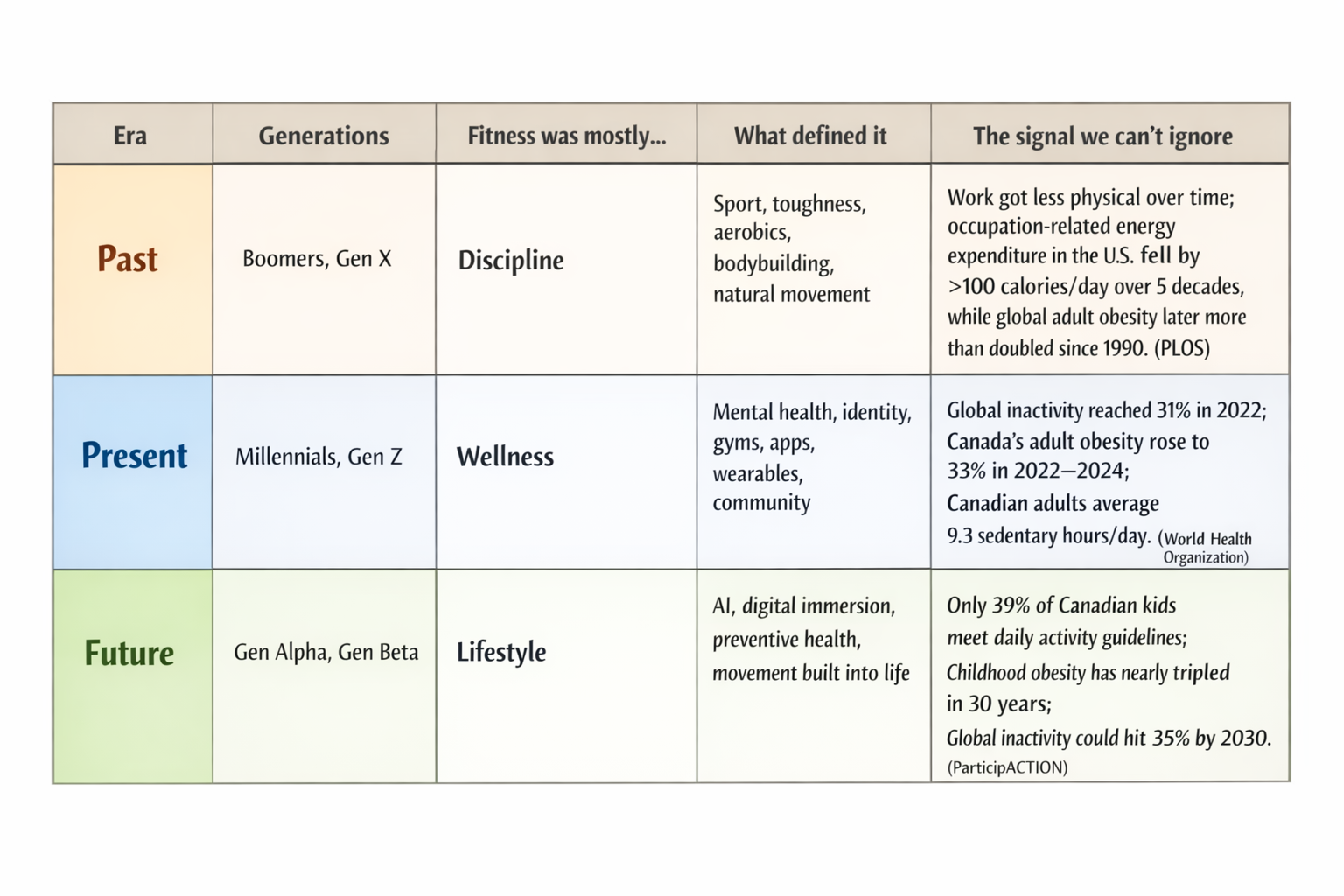
If you zoom out, the story of modern fitness looks like this:
The past: fitness as discipline
The present: fitness as wellness
The future: fitness as lifestyle
That shift didn’t happen by accident.
Over the last 50 years in the U.S., daily occupation-related energy expenditure fell by more than 100 calories per day, largely because work became less physical. Canadian cohort research shows a similar paradox: more recent cohorts report more sedentary behaviour, even while leisure-time physical activity and active commuting have also risen. In plain English: we started scheduling workouts because everyday life stopped giving us movement for free. (PLOS)
The gym grew because natural movement shrank.
The past: fitness as discipline
For Baby Boomers and Gen X, fitness was often framed as toughness, discipline, performance, and body control.
This was the era of jogging booms, aerobics tapes, bodybuilding icons, school sports, and the idea that “fitness” was something serious people did to stay strong, capable, and maybe a little terrifying at the beach. Some people didn’t even call it fitness — they just called it life. Walking more, doing more physical work, moving more out of necessity.
It wasn’t perfect, but it was different.
The world itself demanded more movement back then. And that matters, because today global adult obesity has more than doubled since 1990, with 16% of adults living with obesity in 2022 and 43% of adults overweight worldwide. (World Health Organization)
So when older generations say, “People used to just be more active,” there’s some truth buried in the nostalgia.
Not because the past had better supplements.Not because everyone was meal-prepping chicken and rice in 1984.But because daily life use asked more from the body.
The present: fitness as wellness
Then came Millennials and Gen Z, and fitness changed languages.
Now fitness is also about:
mental health
identity
stress relief
community
self-improvement
wearable data
recovery culture
“hot trending walks,” run clubs, yoga, breathwork, and strength training as therapy
And honestly? That part is progress.
Research is very clear that physical activity helps mental health. A major 2024 review in The BMJ found exercise is an effective treatment for depression, and a 2023 umbrella review in BJSM found physical activity is highly beneficial for depression, anxiety, and distress across adult populations. (BMJ)
So yes — the present generation was right to say fitness is more than aesthetics.
But here’s the paradox: we talk more about fitness than ever, and yet we’re still getting more unfit.
Globally, 31% of adults — about 1.8 billion people — were not meeting physical activity guidelines in 2022, up about 5 percentage points from 2010, and WHO projects inactivity could rise to 35% by 2030 if the trend continues. (World Health Organization)
North America is feeling that contradiction hard. In the U.S., adult obesity was 40.3% during 2021–2023. In Canada, obesity among adults aged 18–79 rose from 25% before the pandemic to 33% in 2022–2024. Canadian adults also spent an average of 9.3 hours a day sedentary, and only about half of Canadian adults get the recommended amount of weekly physical activity. (CDC)
So now we have the modern fitness joke:
Your dad accidentally got cardio from life.You need an app, a watch, two reminders, and a charged phone to take the same walk.
Funny. Also… not funny.
The future: fitness as lifestyle
Now we get to Gen Alpha and Gen Beta — the first generations growing up fully inside digital life.
This is where Father Time and Mother Nature start arguing in public.
Because if the environment keeps getting more convenient, more screen-based, more seated, more automated, and more mentally overloaded, then the future of fitness cannot just be “go harder in the gym.”
It has to become integrated.
In Canada, only 39% of children and youth aged 5–17 meet the recommendation of 60 minutes of moderate-to-vigorous physical activity per day, and childhood obesity in Canada has nearly tripled in the last 30 years. (ParticipACTION)
That means the future challenge is not motivation alone. It is design.
We have to build lives where movement is not treated like a random heroic event, but like something that belongs inside the day. Research on digital and app-based exercise is already showing that thoughtfully designed programs can help people integrate physical activity into everyday life. (PMC)
That is why I believe the future is not:
fitness as punishmentorfitness as trend
It is fitness as lifestyle.
Not because discipline disappears.But because discipline finally learns how to live in the real world.
Where CraftFit sits in this story
This is exactly why CraftFit has chosen its lane so clearly.
CraftFit’s own philosophy is to make fitness something that fits real life — something woven into how you move, think, recover, and show up every day, because “when fitness fits your life, it lasts.” The brand’s training system combines strength and cardiovascular fitness, joint-friendly progression, and simple recovery rituals, and it is designed to scale from shorter 30-minute sessions to fuller training weeks depending on the life a client is actually living. (CraftFit)
Because the future does not need more people trying to copy someone else’s fitness life.
It needs more people building their own.
The conundrum
If Father Time says,“You cannot train for today with yesterday’s lifestyle,”
and Mother Nature says,“I changed the terrain — your work, your food, your cities, your habits, your screens,”
then fitness only has one smart answer:
stop treating movement like an event and start building it like a life.
That’s my view.That’s CraftFit’s view.And honestly, I think that’s the future.
The past taught us discipline.The present taught us wellness.The future will demand lifestyle.
Or, in true CraftFit fashion:
Fit the way you live — so you can keep living well. (CraftFit)
Note: This post is educational and not medical advice. If you’re dealing with depression or mental health challenges, please reach out to a qualified healthcare professional or support services in your area. Fitness can support mental health, but it isn’t a replacement for care.